
Flip Indian Rupess Coin – 1 Rs, 2 Rs, 5 Rs, 10 Rs & 20 Rs
Flip an Indian Coin
Select a coin below and try your luck!
Ready to Flip!
Your Stats
Heads: 0
Tails: 0
Probability: –
Global Stats
Heads: 0
Tails: 0
Probability: –
Flip any Indian rupee coin instantly — ₹1Rs, ₹2Rs, ₹5Rs, ₹10Rs, or ₹20Rs at one coin flip tool. Each flip gives a true 50/50 result, just like a real toss. Used for cricket toss decisions, settling bets, classroom activities, or just having fun. Works on mobile, tablet and desktop — no app needed.
Flip Indian rupee coin online — pick your denomination, get your result, share it on WhatsApp in one tap.
Flipffy – Single Indian Coin Flip Tool
1rs Indian Coin Flip
10rs Indian Coin Flip
How to Flip an Indian Coin Rupess Online
Select your coin — ₹1, ₹2, ₹5, ₹10 or ₹20
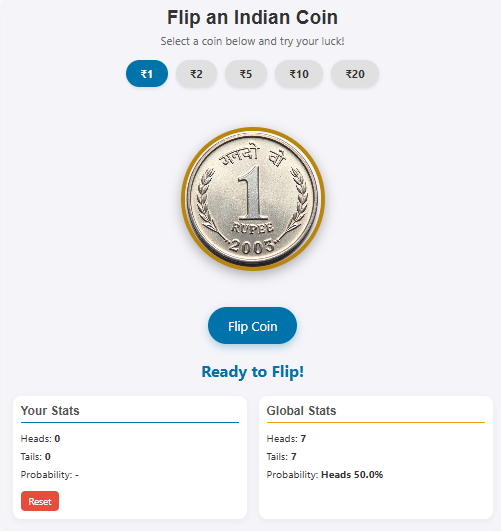
Press Flip Coin or hit the Spacebar
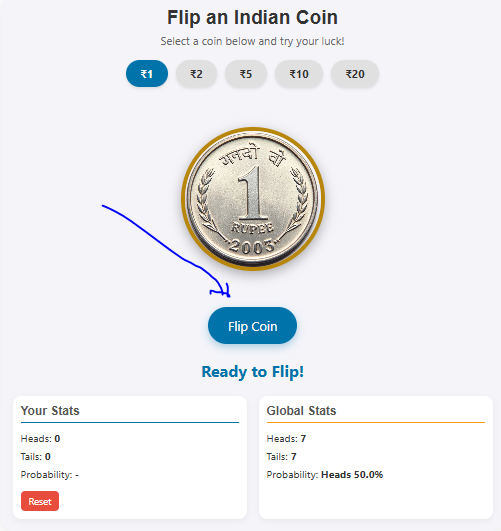
Watch the 3D animation and get your result — Heads or Tails
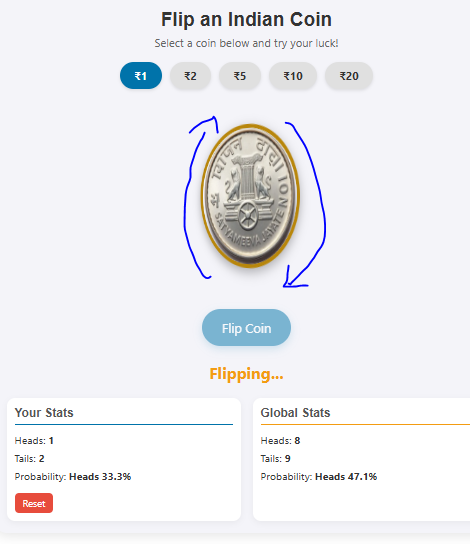
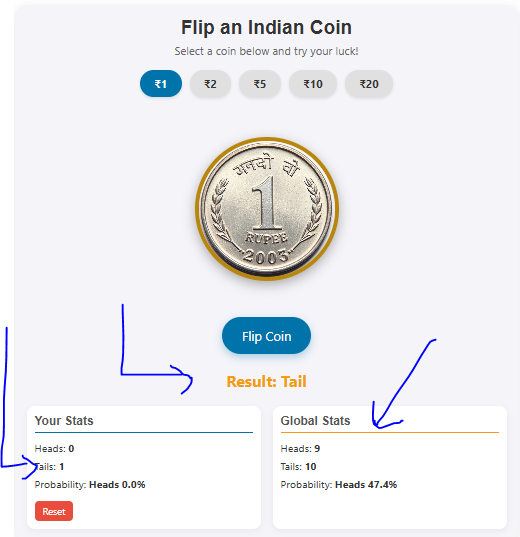
Your personal stats update automatically every flip
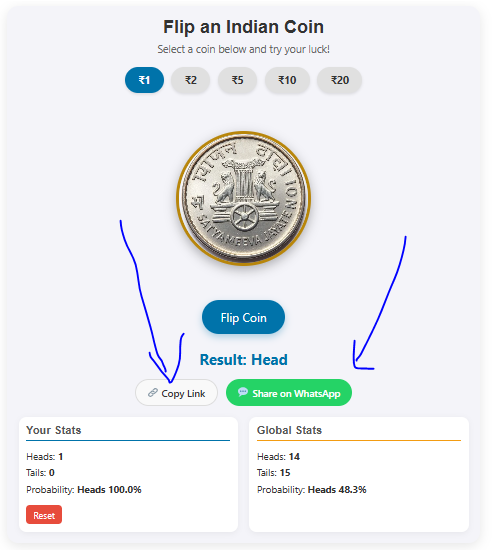
Share your coin flip results
Flip a Indian Coin Rupees – 1rupees, 2rupees, 5rupees, 10rupees, 20rupees
Welcome to Flipiffy‘s complete Indian coin flip collection! Flip authentic digital versions of all circulating Indian rupee coins—from the everyday 1 rupee to the premium 20 rupee bimetallic coin. Each simulator features accurate designs with the iconic Lion Capital of Ashoka, providing perfect 50/50 probability for fair decisions while celebrating India’s rich numismatic heritage.
What is Heads and Tails in Indian Coins?
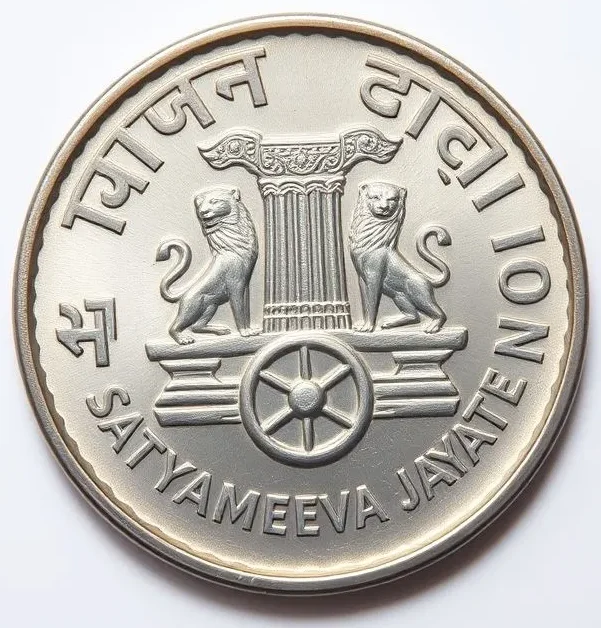
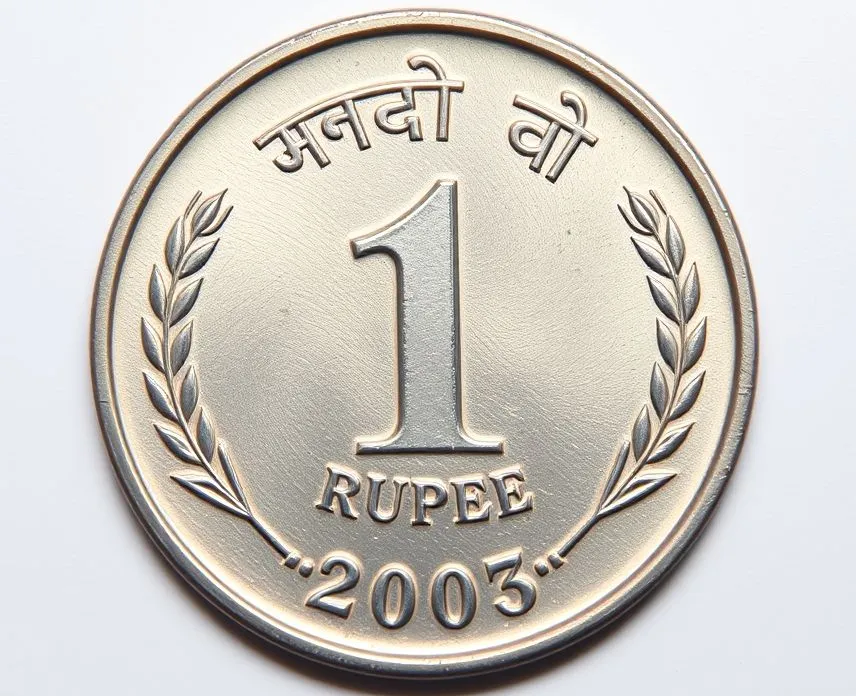
In India, a coin toss is popularly called “Chit ya Pat” — chit being heads (the side with the Ashoka emblem) and pat being tails (the side with the denomination). The Lion Capital of Ashoka on every Indian coin has been the “head” side since 1950 when India minted its first republican coins.
Heads (Chit): The side showing the Lion Capital of Ashoka and “Satyameva Jayate” Tails (Pat): The side showing the coin’s denomination and the ₹ symbol
Choose Your Indian Coin – 1Rs, 2Rs, 5Rs, 10Rs, 20Rs
Flip a 1 Rupee Indian Coin
Most Common Denomination The workhorse of Indian currency, the 1 rupee coin handles countless daily micro-transactions. Features the Lion Capital of Ashoka and “Satyameva Jayate” motto. Perfect for teaching children about Indian currency and basic probability.
- Material: Ferritic stainless steel
- Weight: 3.76g
- Diameter: 21mm
- Use cases: Small purchases, temple offerings, children’s pocket money
Flip a 2 Rupee Indian Coin
Traditional Circular Design Introduced in 1982, replacing the 2 rupee banknote. This coin has evolved through multiple material changes from cupro-nickel to today’s circular ferritic stainless steel design.
- Material: Ferritic stainless steel
- Weight: 4.5g
- Diameter: 25mm
- Use cases: Street food, chai purchases, auto-rickshaw fares
Flip a 5 Rupee Indian Coin
Most Versatile Denomination Launched in 1985 with the Vinoba Bhave commemorative coin. Today’s brass version features the modern ₹ symbol. Home to valuable commemorative editions including the rare Crop Science coin (₹15,000-₹50,000).
- Material: Brass
- Weight: 6g
- Diameter: 23mm
- Use cases: Photocopying, small snacks, bus fares, temple donations
Flip a 10 Rupee Indian Coin
India’s First Bimetallic Coin Revolutionary 2005 introduction combining two metals in one coin. Four design generations exist, all legal tender. The 2016 fake coin controversy led to nationwide confusion requiring RBI clarification.
- Material: Bimetallic (nickel-bronze outer, stainless steel core)
- Weight: 7.71g
- Diameter: 27mm
- Use cases: Vending machines, government fees, parking meters
Flip a 20 Rupee Indian Coin
India’s Highest Denomination Launched May 2020 during COVID-19 pandemic. Dodecagonal (12-sided) shape designed by National Institute of Design students. Features eight grain stalks honoring India’s agricultural heritage.
- Material: Bimetallic (two copper-zinc-nickel alloys)
- Weight: 8.54g (heaviest Indian coin)
- Shape: Dodecagon (12-sided)
- Use cases: Premium offerings, metropolitan transport, retail change
All Indian Coins You Can Flip
| Coin | Shape | Material | Head Side | Tail Side |
|---|---|---|---|---|
| ₹1 | Round | Ferritic stainless steel | Ashoka emblem | “1 Rupee” |
| ₹2 | Round | Ferritic stainless steel | Ashoka emblem | “2 Rupees” |
| ₹5 | Round | Brass | Ashoka emblem | “5 Rupees” |
| ₹10 | Round | Bimetallic | Ashoka emblem | “10 Rupees” |
| ₹20 | 12-sided | Bimetallic | Ashoka emblem | “20 Rupees” |
Common Uses for Indian Coin Toss
- Cricket toss — deciding who bats or bowls first
- Kabaddi & sports — choosing court or starting side
- Classroom decisions — fair group assignments
- Daily choices — where to eat, who goes first in a game
- Chit ya Pat games — the classic Indian playground game
Understanding Indian Coin History
From Ancient Times to Modern India
Indian coinage dates back to 600 BCE with punch-marked silver coins. The medieval period saw Sher Shah Suri introduce the silver rupiya in the 16th century, standardizing Indian currency. The British adapted the rupee system during colonial rule, and after independence in 1947, India minted its first republican coins in 1950.
The Decimal Transition (1957)
In 1957, India shifted to the decimal system, dividing 1 rupee into 100 paise instead of the old 16 anna system. This modernization aligned Indian currency with international standards while maintaining the rupee as the base unit.
Current Circulation
Today, circulating coins exist in denominations of 1, 2, 5, 10, and 20 Indian rupees, all produced by four mints located in Kolkata, Mumbai, Hyderabad, and Noida. Each mint has a distinct mark, making coins slightly unique to collectors.
The Rupee Symbol (₹)
In 2010, a new rupee sign (₹) was officially adopted, derived from the combination of the Devanagari consonant “र” (ra) and the Latin capital letter “R”. The parallel lines at the top allude to the Indian flag and symbolize the nation’s desire to reduce economic disparity. The first series of coins with the new rupee sign started circulation on 8 July 2011.
The Four Indian Mints
Mumbai Mint (Established 1829)
The oldest Indian mint, founded during British rule. Produces millions of coins annually with distinctive marking (◆ or B).
Kolkata Mint (Operating since 1831)
Second-oldest facility with nearly 200 years of minting history. Coins have no mint mark, making them unique.
Hyderabad Mint (Started 1903)
Established in early 20th century, features star symbol (⋆) as mint mark on produced coins.
Noida Mint (Opened 1988)
Newest and most modern facility using advanced technology. Mint mark is a dot (●).
The Lion Capital of Ashoka
Every Indian coin features the Lion Capital of Ashoka, India’s national emblem adopted in 1950. This ancient sculpture from Sarnath (3rd century BCE) shows four Asiatic lions standing back to back atop a circular abacus decorated with animal sculptures.
The lions symbolize power, courage, confidence, and pride. Below the capital, the motto “Satyameva Jayate” (Truth Alone Triumphs) appears in Devanagari script on all coins. This timeless symbol connects modern Indian currency to 2,300 years of subcontinental heritage.
Try All Indian Coin Denominations
Experience the complete range of Indian currency from the humble 1 rupee to the premium 20 rupee coin. Each flip provides perfect fairness while celebrating India’s numismatic excellence.
Choose your denomination. Make your call. Let the rupee decide.
Frequently Asked Questions
Which side is heads and tails in an Indian coin?
Heads is the side showing the Ashoka pillar (Lion Capital). Tails is the reverse side showing the coin’s value like “₹1”, “₹5” etc.
What is “Chit ya Pat” in coin toss?
Chit ya Pat is the Hindi phrase for heads or tails. Chit = heads (Ashoka side), Pat = tails (denomination side). It’s the most common way Indians refer to a coin toss.
Is the online coin flip truly random?
Yes. Our simulator uses JavaScript’s Math.random() which gives a statistically fair 50/50 result every single flip — the same probability as a physical coin.
Can I flip a 10 rupee coin online?
Yes. Select ₹10 from the coin selector above. We use actual 10 rupee bimetallic coin images with the real head and tail sides.
What is head and tail in 1 rupee coin?
The head of a 1 rupee coin is the side with the Lion Capital of Ashoka. The tail shows “1 Rupee” with the ₹ symbol. On our simulator you can see both sides in the 3D flip animation.