
Alternate to Popsicle Sticks in the Classroom: 9 Easy Ways Teachers Can Pick Students Fairly
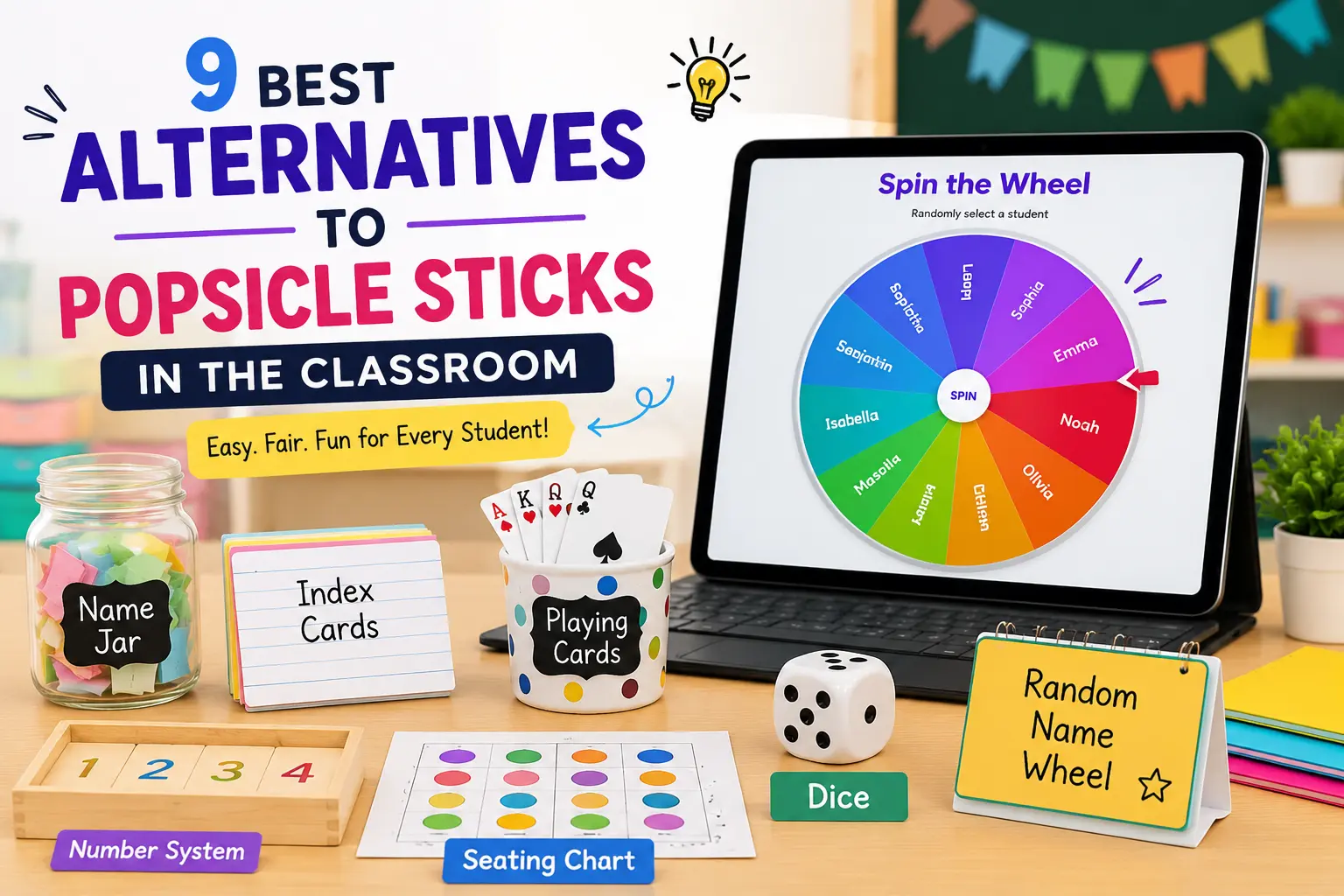
Alternate to Popsicle Sticks in the Classroom
If you’ve been teaching for a while, you’ve probably used popsicle sticks with student names written on them.
It’s one of the easiest ways to choose a student without playing favorites. Ask a question, pull out one stick, and that’s who answers.
It still works today.
But after a few weeks, small problems start showing up.
Maybe a few sticks go missing. A new student joins your class. Someone transfers to another school. Some names become hard to read because the marker fades.
Before you know it, you’re making a new set of sticks again.
The good news is that popsicle sticks aren’t your only option. There are plenty of simple ways to pick students randomly, and some of them save both time and effort.
Let’s look at a few classroom-friendly alternatives.
Why Teachers Use Random Selection
Not every student raises their hand.
Some students answer every question, while others stay quiet even when they know the answer.
Random selection gives everyone the same chance to participate.
It also keeps students paying attention because they know their name could be picked at any time.
Many teachers use random selection for:
- Answering questions
- Reading aloud
- Solving problems on the board
- Choosing group leaders
- Picking classroom helpers
- Starting presentations
- Classroom games
The goal isn’t to put students on the spot. It’s to make participation fair.
1. Random Name Wheel
This is probably the easiest replacement for popsicle sticks.
Instead of writing names on wooden sticks, you type your class list into a digital wheel.
Whenever you need a student, click Spin.
The wheel randomly picks one name.
That’s all.
For example, imagine you’re teaching science to 28 students.
You finish explaining photosynthesis and ask a question.
Instead of looking through a cup of sticks, you spin the wheel.
Within a few seconds, one student’s name appears.
Everyone can see the result, so students know the choice was random.
Another nice thing is that you only need to enter names once. If a new student joins, simply add one more name. No need to rewrite an entire set of sticks.
If you’re looking for a free option, Flipiffy Spin the Wheel lets you add names, shuffle them, and pick a student in seconds.
2. Index Cards
Index cards work almost the same way as popsicle sticks.
Write one student’s name on each card.
Shuffle them before class or keep them in a small box.
When you need someone to answer, pull out one card.
Some teachers even write extra information on the back of each card, such as birthdays, reading levels, or fun facts. That makes the cards useful for more than just choosing students.
3. Name Jar
This method is simple and inexpensive.
Write each student’s name on a small piece of paper.
Fold the papers and place them in a jar.
Whenever you need a volunteer, mix them up and pick one.
Many elementary school teachers like this because students enjoy watching the teacher draw a name.
4. Playing Cards
A regular deck of playing cards can also help.
Give every student one card.
Keep another matching deck for yourself.
When you draw a card, the student holding the matching card answers the question.
This works especially well during review games or classroom competitions.
5. Number Your Students
Some teachers assign every student a classroom number.
Instead of picking names, you simply choose a random number.
For example:
1 – Emma
2 – Liam
3 – Sophia
4 – Noah
If today’s random number is 12, student number 12 answers.
This method works well if your seating chart doesn’t change very often.
6. Response Boards
Sometimes you don’t need to choose just one student.
You may want every student to answer.
Give each student a small whiteboard or laminated sheet.
Ask a question.
Everyone writes an answer.
When you say “Show me,” students hold up their boards.
Within a few seconds, you can see who understands the lesson and who may need extra help.
7. Classroom Apps
Many teachers already use classroom apps for attendance or assignments.
Some of these apps also include random student pickers.
The advantage is that everything stays in one place.
The downside is that some apps require subscriptions or extra setup before you can use them.
8. Seating Chart
If your students always sit in the same seats, a seating chart can work surprisingly well.
Print your classroom layout.
Whenever you call on a student, place a small check mark beside their name.
Over time, you’ll notice if you’ve been calling on certain students more often than others.
It’s a simple way to keep participation balanced.
9. Spin the Wheel for Classroom Activities
A random wheel isn’t just for choosing who answers questions.
Teachers use it for many different classroom activities.
For example:
- Pick today’s classroom helper.
- Choose group leaders.
- Decide which team goes first.
- Select a student to read.
- Pick presentation order.
- Choose quiz participants.
- Give away small classroom rewards.
- Select a discussion leader.
Students usually enjoy watching the wheel spin.
Even quiet students become curious to see whose name will appear next.
Why Many Teachers Are Switching to Digital Tools
Popsicle sticks still work.
There’s nothing wrong with using them.
But digital tools make a few things easier.
You don’t have to carry anything between classrooms.
You don’t lose sticks.
Adding or removing student names takes only a few seconds.
They also work for online classes, something popsicle sticks can’t do.
If you teach different classes during the day, you can save separate name lists for each class and switch between them whenever needed.
Is a Random Name Wheel Better Than Popsicle Sticks?
That depends on how you teach.
If you enjoy hands-on classroom materials, popsicle sticks are still a good choice.
But if you want something quicker and easier to manage, a random name wheel can save time every day.
The biggest advantage is convenience.
Everything stays on one screen.
There are no sticks to organize, no names to rewrite, and no materials to replace.
Try Flipiffy Spin the Wheel
If you’re looking for an easy alternative to popsicle sticks, give Flipiffy Spin the Wheel a try.
Just enter your students’ names once.
Click Spin whenever you need to choose someone.
The wheel randomly selects a name, making classroom participation simple and fair.
It works well for elementary classrooms, middle school, high school, tutoring sessions, and even online classes.
Whether you’re asking review questions, picking group leaders, or choosing classroom helpers, it’s a quick way to keep every student involved.
Frequently Asked Questions
What can I use instead of popsicle sticks in the classroom?
You can use a random name wheel, index cards, a name jar, playing cards, student numbers, response boards, classroom apps, or a seating chart. Each method helps you choose students fairly.
Do teachers still use popsicle sticks?
Yes. Many teachers still use them because they’re simple and inexpensive. However, more teachers are also using digital tools because they’re easier to update and don’t require physical materials.
Is a random name wheel fair?
Yes. Every student’s name has the same chance of being selected, so students know the teacher isn’t choosing favorites.
Can I use a random name wheel in online classes?
Yes. Simply share your screen and spin the wheel during the lesson. Students can watch the wheel choose a name in real time.
Which alternative is the easiest?
For many teachers, a random name wheel is the easiest because you only enter student names once. After that, selecting a student takes just one click.