
How a Coin Toss Decided Who Would Make the First Flight in History
It was December 1903. Two brothers from Dayton, Ohio stood on a freezing beach in North Carolina with the most ambitious machine ever built. After years of failed experiments, broken parts, and brutal wind, they were finally ready to attempt something no human had ever done — powered flight.
But before either of them could climb aboard, there was one question left to answer: who goes first?
They settled it the same way people have settled arguments for centuries. They flipped a coin.
The Setup: Kill Devil Hills, December 14, 1903
Wilbur and Orville Wright had been testing gliders at Kitty Hawk, North Carolina since 1900, drawn there by its strong, consistent winds and remote location. By late 1903, they had attached a 12-horsepower engine — built themselves in their bicycle shop back in Dayton — to their latest glider, now called the Wright Flyer.
Before making their historic attempt, the brothers flipped a coin to determine who would fly first. Wilbur won the coin flip to pilot the Wright Flyer on their first powered flight attempt on December 14, 1903.
It should have been the moment. But it wasn’t — at least not yet.
Wilbur’s Attempt: The Coin Winner Who Crashed
Forty feet down the launching rail, the Flyer lurched up, stalled, and smashed into the sand. The forward elevator was slightly damaged, requiring repair, but the brothers were undeterred.
Because Wilbur pulled too hard on the rudder, the Flyer surged upward at a steep angle, and he brought it down abruptly. The flight lasted only 3.5 seconds before the crash. Minor repairs were needed, and the attempt was rescheduled.
Winning the coin toss, it turned out, wasn’t the advantage it seemed.
Orville’s Turn: December 17, 1903 — The Flight That Changed Everything
Three days later, with repairs done, the brothers were back. The day began with a bitter 27-mph headwind, strong enough to lift sand in sweeping sheets across the dunes. This time, it was Orville’s turn.
Orville won the coin toss to fly the machine, and men were assigned to balance it by holding its left wing and tail while Wilbur held the right wing. The Wrights each turned a propeller to start the motor, and Orville lay on his stomach between the wings.
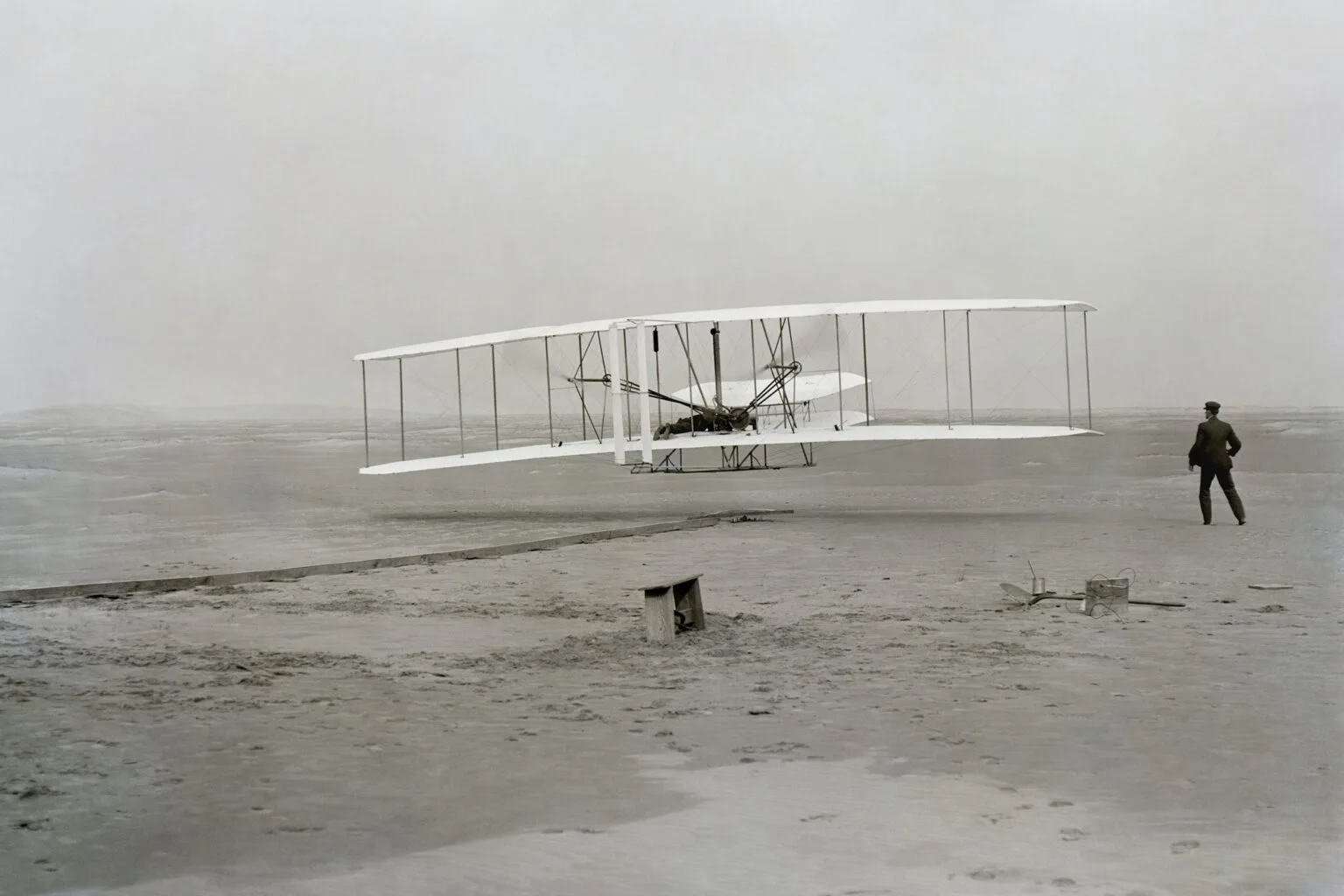
At 10:35 a.m., he made the first heavier-than-air, machine-powered flight in the world. In a flight lasting only 12 seconds and covering just 120 feet, Orville did what men and women had only dreamed of doing for centuries — he flew.
That one coin toss on December 14th meant Wilbur went first, crashed, and handed the honor of the official first flight in history to his younger brother by default.
The Photo Nobody Expected
A single photograph captured the moment of takeoff. It was taken by John T. Daniels, a lifesaving station worker who had never used a camera before — and never did again. Orville had set up the camera beforehand and asked Daniels to press the shutter at the exact moment the Flyer left the track. That iconic image exists entirely because of one man’s first and only photo.
What Happened the Rest of That Day
The brothers didn’t stop after that first 12-second flight. They took turns flying three more times that morning. Wilbur flew their plane for 59 seconds, covering a distance of 852 feet on the final attempt — nearly the length of three football fields.
Then the wind had the last word. As they wheeled the Flyer back toward camp, a gust of wind suddenly flipped the aircraft repeatedly, damaging it beyond immediate repair. The Wright Flyer never flew again.
The Coin Toss That History Forgot
Most people remember December 17, 1903 as the day flight was invented. Few remember that a simple coin toss on December 14th quietly shaped who would go down in the history books.
If Wilbur had not crashed on his coin-winning attempt, he — not Orville — would likely be the name attached to the first flight. History, as it so often does, turned on a tiny, random moment.
A coin in a vest pocket. A flip. A call.
Coin Flips Have Shaped More History Than You Think
The Wright brothers are not alone. In 1845, the city of Portland, Oregon got its name from a coin toss between two landowners — one wanted to name it Boston, the other Portland. In the 1968 European Football Championship, Italy advanced to the final after winning a coin toss against the Soviet Union in a game that ended 0-0 after extra time.
From city names to championship finals to the first powered flight — a simple coin flip has quietly changed the course of history more times than most people realize.
Next time you need to make a decision, remember: even the Wright brothers left it to chance.
References
History News Network — Coin Tossing Through the Ages
https://www.historynewsnetwork.org/article/coin-tossing-through-the-ages
Wikipedia — Wright Brothers First Flight
https://en.wikipedia.org/wiki/Wright_brothers
Wikipedia — Wright Flyer (December 17, 1903)
https://en.wikipedia.org/wiki/Wright_Flyer
Smithsonian National Air and Space Museum — First Flight
https://airandspace.si.edu/stories/editorial/birth-aviation-wright-brothers
History.com — Wright Brothers
https://www.history.com/topics/inventions/wright-brothers
National Park Service — Wright Brothers National Memorial
https://www.nps.gov/wrbr/index.htm