
Flip A Coin Yes or No
Current Session
Global Stats
How to Use Yes or No Coin Flip Tool
Using this tool takes less than five seconds.
Step 1: Focus on Your Question
Think of a question that can be answered with YES or NO. Keep it clear and specific.
For example:
- Should I go out today?
- Should I message them?
- Should I start this project now?
Step 2: Click “Flip for Yes/No”
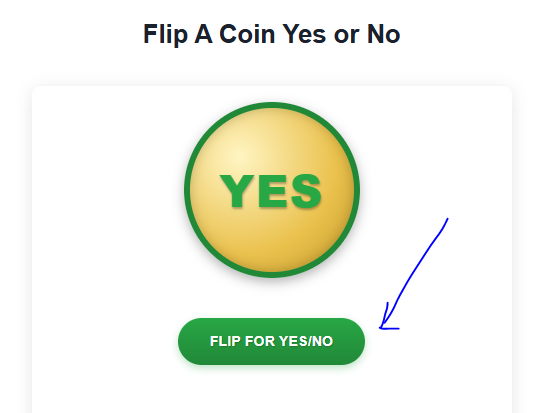
Press the button. The coin will spin with a short animation and sound effect.
Step 3: Get Your Result
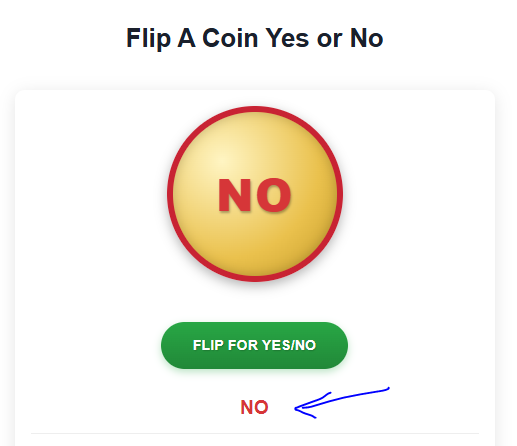
After the animation finishes, the tool displays either YES (green) or NO (red).
Step 4: Review Your Stats (Optional)

You can see:
- How many YES results you’ve received
- How many NO results you’ve received
- Your total flips
If you want to start fresh, click “Reset Current” to clear the session stats.
That’s it. No setup. No login. No complicated steps.
lip a Coin Yes or No – Instant Decision Maker
Sometimes you don’t need a long pros-and-cons list.
You just need a clear answer.
This Yes or No Coin Flip tool gives you a fast, fair, and completely random decision in seconds. Click the button, watch the coin spin, and get a clean “YES” or “NO” result. No bias. No overthinking. Just a simple outcome.
If you’ve ever struggled to make small decisions, this tool is built exactly for that moment.
What Is the Yes or No Coin Flip Tool?
This is a digital version of a classic coin toss.
Instead of flipping a physical coin, the tool uses a random 50/50 probability system to generate either “YES” or “NO.” Each flip has an equal chance of landing on either side. That means:
- 50% chance for YES
- 50% chance for NO
- Completely independent results each time
The animation simulates a real coin spin, and the system tracks your results in two ways:
- Current Session Stats – Shows how many YES and NO results you’ve gotten during your active session.
- Global Stats – Displays cumulative counts (including saved data), giving you a broader perspective of overall usage.
It’s simple on the surface. But it’s surprisingly powerful when you need quick clarity.
When Should You Use a Yes or No Coin Flip?
This tool works best when:
You’re Overthinking Small Decisions
Sometimes the real problem isn’t the decision. It’s hesitation. A quick coin flip removes mental friction and forces movement.
You Need a Neutral Tie-Breaker
Stuck between two equal options? Let randomness decide. It’s fair and unbiased.
You Want a Fun Way to Decide
This works great for:
- Game night choices
- Classroom participation
- Friendly challenges
- Lighthearted debates
You’re Testing Probability
If you’re teaching probability concepts or demonstrating randomness, this tool shows 50/50 distribution clearly through session tracking.
You Want a Psychological Nudge
Here’s something interesting. When the coin lands, you might immediately feel relief or disappointment.
That reaction often tells you what you actually wanted.
In that sense, the tool isn’t just random. It’s revealing.
Why Use a Digital Coin Flip Instead of a Real Coin?
You could flip a physical coin.
But this version gives you extra advantages:
Instant stats tracking
No need to count manually. The tool keeps track for you.
Session reset control
Clear results anytime and start over.
Always available
No coin? No problem. Works on desktop and mobile.
Visual clarity
Large animated result with color indicators makes the outcome unmistakable.
Plus, it’s consistent. No worries about uneven surfaces or coins landing awkwardly.
Yes or No Coin Flip Tool is It Truly Random?
Yes.
Each flip uses a standard 0.5 probability check. Every outcome is independent from the previous one. That means:
A YES result does not increase or decrease the chance of the next result being YES.
It’s pure 50/50 every time.
If you flip 10 times and get 7 YES results, that doesn’t mean NO is “due.” Each flip resets the probability.
This makes it useful not only for decisions but also for understanding how randomness actually behaves.
Smart Ways to Use This Yes or No Tool
Here are a few creative use cases:
Daily Productivity Push
Ask: “Should I start now?”
If it says YES, you begin immediately.
If it says NO, wait five minutes and flip again.
Workout Motivation
“Should I train today?”
Let the coin remove hesitation.
Content Ideas
Use it to narrow down two headline variations.
Game Mechanics
Integrate it into trivia nights, classroom activities, or online challenges.
Breaking Decision Paralysis
If you’re stuck in analysis mode, randomness forces momentum.
Sometimes progress matters more than perfection.
Final Thoughts
The Yes or No Coin Flip tool is simple by design.
It removes complexity.
It eliminates bias.
It speeds up decisions.
Whether you’re resolving a small daily dilemma or just having fun, this tool delivers instant clarity with zero effort.
Click. Flip. Decide.